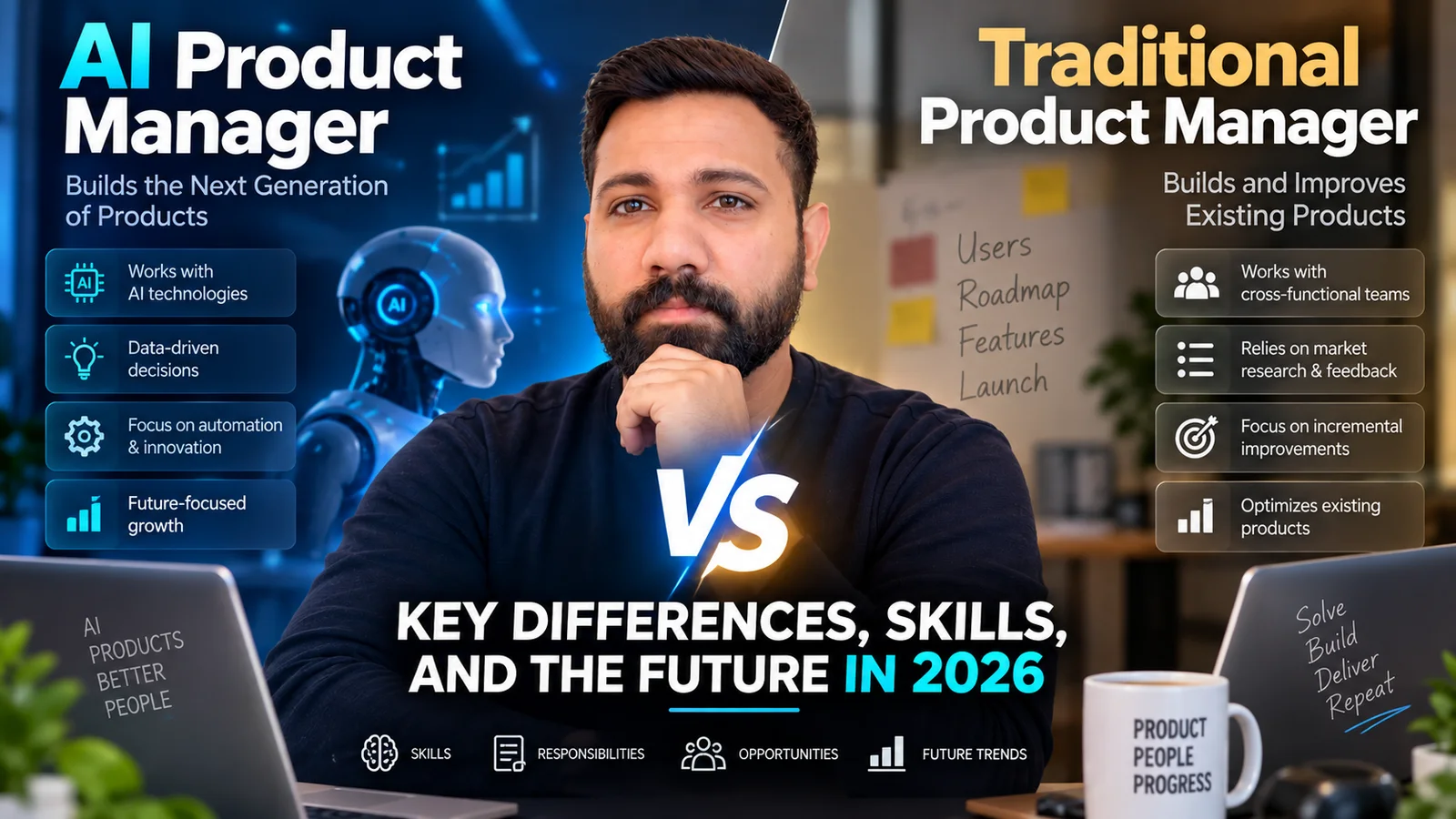
AI Product Manager vs Traditional Product Manager: What Actually Differs in 2026
- First, "AI Product Manager" is three different jobs
- Where the two roles actually diverge
- Where they don't differ at all
- The stakeholder map changes shape
- The failure modes are different
- What this does to compensation
- How to read an "AI Product Manager" job advert
- How the interviews differ
- Should you actually become an AI PM?
- If you're a traditional PM reading this with mild panic
- Frequently asked questions
- The short version
- Sources
Here's the answer most comparison posts won't give you: about four fifths of the two jobs are identical, and the remaining fifth is where every interview, every pay negotiation and every bad hire now happens.
I've worked both sides. I ran delivery and product on conventional software for years before moving into AI product work, and the transition was not the reinvention people describe on LinkedIn. Most days I do the same job I did before. Then there are the days where none of my old instincts apply, and those days are the entire difference.
This is a breakdown of exactly where the line falls, written for two people: the traditional PM wondering whether to make the jump, and the hiring manager who keeps writing job adverts that describe one role and pay for another.
First, "AI Product Manager" is three different jobs
Most of the confusion in this comparison comes from a single word doing too much work. When someone says AI PM, they could mean any of three roles that share almost nothing except a line on a business card.
The AI-enabled PM
Builds ordinary software. Uses AI to do the job faster.
The AI feature PM
Ships AI features inside a conventional product.
The AI platform PM
Owns the model, the pipeline or the agent itself.
The AI-enabled PM builds ordinary software and uses AI to do the job faster: better first drafts, faster synthesis, quicker prototypes. This is now simply what product management looks like. Around 96% of product professionals report frequent AI use in ProductPlan's 2026 research, so this isn't a specialisation. It's the baseline.
The AI feature PM ships AI capability inside a conventional product: a summariser in an HR platform, a support assistant in a SaaS tool, a matching engine in a marketplace. The surrounding product is normal. The feature is not, and that's where the new work lives.
The AI platform PM owns the model, the retrieval layer, the agent, or the API other teams build on: data strategy, latency budgets, safety posture, model selection. This is the most technical version of the role, and the one that carries the real pay premium.
Most job adverts titled "AI Product Manager" are describing the second job while benchmarking pay against the first. If a comparison of AI PM and traditional PM feels contradictory when you read three of them in a row, that mismatch is usually why.
For the rest of this article, "AI PM" means the second and third roles. The first one is just a PM with better tools.
Where the two roles actually diverge
Same lifecycle, six stages. Here's what changes at each one.
| Stage | Traditional PM | AI Product Manager |
|---|---|---|
| Discovery | Interviews, tickets, usage analytics | Same, plus failure logs as a data source |
| Definition | PRD with acceptance criteria | Eval set with a rubric and a quality bar |
| Estimation | How long to build it | How many iterations to reach the quality bar |
| Build & QA | Deterministic tests, pass or fail | Regression suite over a golden dataset |
| Launch | Feature flag, phased rollout | Confidence thresholds, fallbacks, disclosure |
| Measure | Adoption, retention, conversion | Plus groundedness, containment, cost per task |
The six stages where the work stops being the same work.
Discovery: nearly identical, with one new input
You still interview customers, read tickets, watch session recordings and argue about which segment matters. Nothing about probabilistic systems changes the fact that people are bad at telling you what they want.
The one addition is that your product now generates a research corpus on its own: eval failures, low-confidence outputs, the queries the assistant refused, the responses users edited before sending. That last signal is the most underrated source of product insight I've worked with. When someone rewrites an AI-generated output, they're annotating your quality problem for free.
Definition: the PRD versus the eval set
This is the sharpest break between the two roles.
A traditional PM writes acceptance criteria that a build either satisfies or doesn't. "The export button generates a CSV with these seven columns" is testable, binary and final.
An AI PM cannot write that sentence about a probabilistic feature. There is no build step that guarantees "summarises accurately." So the artifact changes: instead of acceptance criteria, you define a quality bar and a test set that measures against it — a concrete definition of good, twenty representative inputs including the deliberately awkward ones, a rubric, and a pass rate you'll ship at. I went deeper on what that evaluation layer looks like day to day in how AI is changing product management in 2026.
The PRD doesn't disappear. The section that used to carry all the weight now looks more like a test plan than a specification.
Estimation: build time versus iterations
Ask a traditional PM how long a feature takes and they'll give you a build estimate with a confidence range. That's a solvable problem with well-understood techniques.
Ask an AI PM the same question and the honest answer is that the build is often the short part. What's unknown is how many iterations of prompt, retrieval and data work it takes to move quality from where it starts to where it needs to be. Sometimes that's two weeks. Sometimes the quality bar isn't reachable at acceptable cost, and the correct output of the sprint is a decision not to ship.
Traditional PMs commit to dates. AI PMs commit to quality bars and time-box the discovery of whether they're achievable. Learning to say that to an executive without sounding evasive is a genuine skill.
Build and QA: deterministic tests versus regression over a golden set
A conventional feature passes QA once and stays passed unless someone changes the code. An AI feature can degrade without anybody touching your repository, because a provider updated a model, a document got reindexed, or your prompt hit a different context length.
So AI PMs live with a regression suite running against a fixed dataset, and they care about it in a way most PMs never had to care about tests. Silent quality regression is the single most common way an AI feature dies quietly after launch.
Launch: feature flags versus confidence thresholds
Both roles do staged rollouts. The AI PM adds a layer underneath: what happens when the system isn't sure.
Confidence thresholds, escalation to a human, citation grounding, a graceful admission of not knowing. In most AI features I've shipped, the fallback path took more design time than the happy path and mattered more to user trust. A traditional PM designs the success case and handles errors. An AI PM designs the uncertainty case as a first-class part of the product.
Disclosure belongs here too. Telling users they're interacting with AI is now a legal requirement in the EU under Article 50 of the AI Act, in effect since 2 August 2026, and it's a design problem rather than a footer.
Measurement: same metrics, plus a second layer
Adoption, retention, conversion and NPS still apply. They just don't tell you whether the AI part works.
On top of the usual set, an AI PM tracks quality (eval pass rate, groundedness), usefulness (acceptance rate, how much users edit the output), autonomy (containment and escalation rates) and economics (cost per resolved task).
That last one deserves emphasis, because it's the metric traditional PM instincts get most wrong. Software people spent two decades internalising near-zero marginal cost. Inference is variable cost. It scales with usage, and on a flat-rate seat price, your heaviest users can be your least profitable ones. AI PMs carry a COGS conversation that traditional PMs on SaaS products almost never had to have.
Where they don't differ at all
Now the part that gets undersold, and it's the larger part.
The skill overlap is bigger than the gap
Roughly four fifths of the craft is shared. Hiring processes test the other fifth.
Traditional PM
- —Requirements gathering
- —Release trains and dependencies
- —Deterministic QA sign-off
The shared core
- —Problem selection
- —Customer empathy
- —Prioritisation
- —Stakeholder trust
- —Writing clearly
- —Data literacy
- —Roadmap strategy
- —Saying no
AI Product Manager
- —Eval design
- —Model & retrieval tradeoffs
- —Failure-mode and fallback design
- —Inference unit economics
- —AI governance classification
Every one of those shared-core items is identical across both roles, and every one of them is where seniority actually lives. Productboard's 2026 skills research ranks data literacy, synthesising customer insight, systems thinking and strategic thinking above AI/ML knowledge itself. That ordering is not sentiment. It reflects the fact that a model will happily generate forty feature ideas and cannot tell you which one your company should bet two quarters on.
I have never seen anyone get hired as an AI PM on the technical wedge alone. I have seen plenty of strong generalist PMs get hired into AI roles and pick up the wedge in a quarter.
The stakeholder map changes shape
A traditional PM's working orbit is engineering, design, sales, support and whoever runs the roadmap review. An AI PM keeps all of those and adds three that used to be occasional:
- Data and ML engineering, who own the layer where most of your quality problems actually live.
- Legal and compliance, who move from a launch-day checkbox to an early-roadmap participant, particularly if you work in hiring, credit, education or healthcare, where the EU AI Act's Annex III obligations apply from December 2027.
- Finance, because someone has to reconcile per-call inference cost with the pricing model.
If you like the political and cross-functional part of product management, the AI role gives you more of it. If that's the part you were hoping to escape, this is worth knowing before you jump.
The failure modes are different
A traditional PM's classic failure is building the wrong thing well: beautiful execution, no demand.
An AI PM's classic failure is building the right thing at a quality level nobody can defend. The demand is real, the demo was convincing, and the thing hallucinates twice a week in front of a customer's customer. MIT research cited throughout 2026 found roughly 95% of enterprise AI pilots produced no measurable ROI, and in my experience that number is less about model capability than about nobody defining, before the build started, what would have to be true for the thing to be worth shipping.
The second failure mode is specific to this era: the demo-to-production gap. A rough prototype takes an afternoon now. The last 20% still takes 80% of the effort, and a convincing demo makes that dramatically harder to explain to the stakeholder who has just watched the thing "work."
What this does to compensation
Every credible 2026 source reports a premium for AI product roles. None of them agree on its size.
The pay premium, and why the numbers disagree
Reported premium over a same-level generalist PM, by source.
Shaded band marks the 15–25 range referenced in the text.
The defensible range is roughly 15 to 25% over a same-level generalist PM. People in AI and IdeaPlan both land in the mid-teens to twenty; KORE1 reports 10 to 25% at the same level; Techademy puts it at 15 to 30%. Outliers reporting 46% or 65% are usually comparing different countries or different seniority bands rather than different titles, so treat them as noise.
Three things worth knowing before you use any of these numbers in a negotiation:
- The premium attaches to the work, not the title. KORE1's data makes this point sharply: when the role owns real model work, a senior AI PM clears well above a senior PM on a non-AI product. When the role is bolt-on feature work with an AI label, the gap closes to almost nothing.
- The published figures are overwhelmingly American. US medians circulate as though they're global. They aren't. European bands sit substantially lower, and a Stockholm or Berlin offer benchmarked against a San Francisco median is a conversation that ends badly.
- Demand is real but the category is smaller than it feels. AI PM roles account for roughly 8 to 10% of open product management positions, with close to half concentrated in the US. Meanwhile around 61% of PM job postings now mention AI experience, which tells you the skill is becoming a requirement for ordinary PM roles faster than the specialist title is spreading.
That last point is the one I'd underline. The realistic outcome for most PMs isn't becoming an AI PM. It's that AI fluency becomes a hiring filter for the job they already have.
How to read an "AI Product Manager" job advert
Because the title is doing three jobs, the advert is where you find out which one you're being offered.
Reading an "AI Product Manager" job advert
How to tell a real AI product role from a retitled one before you spend six weeks interviewing.
Worth your time
- Names the model or stack it runs on
- Mentions evaluation, quality bars or failure modes
- Has an ML or data engineer on the same team
- Talks about latency, cost per call or accuracy targets
- Asks who owns the training or retrieval data
Probably retitled
- "AI-first mindset" with no AI in the product
- AI listed as one bullet among fifteen responsibilities
- No engineer named anywhere in the interview loop
- Success measured only as feature delivery
- Same pay band as the generalist PM role posted last month
Three or more signals from the right-hand column, and the premium in the offer letter will not survive contact with the work.
How the interviews differ
Traditional PM loops test product sense, execution, analytics, estimation and stakeholder judgment. AI PM loops test all of that and add two things.
The first is an AI product case: here's a feature that's hallucinating, or refusing valid requests, or too slow. Walk us through diagnosis, fallback design, the eval you'd build and how you'd measure improvement. The failure mode candidates hit is treating it as a model-selection question — the interviewer is listening for measurement, not model names.
The second is a live spec exercise that explicitly includes evals and failure handling. Thirty minutes, a new AI feature, and if you produce a classic PRD with acceptance criteria you've answered the wrong question.
If you want to prepare for one of these, don't take a course. Ship one small AI feature with a real eval set, document three failures you found before users did, and be able to talk through what you changed as a result. That single artifact outperforms any certification currently on the market.
Should you actually become an AI PM?
Three honest cases where the answer is no.
If you love the pure strategy and portfolio end of product work, the AI role pulls you toward the technical and operational end. That's a real trade, not just an upgrade.
If you're hoping the title solves a career plateau, it won't. The shared core is where seniority is assessed, and a plateau there follows you into the new role.
If you'd be joining a company that wants AI features but has no data engineer, no eval infrastructure and no appetite for a quality bar, you're not taking an AI PM job. You're taking a demo job with an AI PM title.
The case for yes is simpler. If you like being close to how the thing actually works, if you're comfortable committing to a quality bar instead of a date, and if the idea of breaking your own product on purpose before a customer does it by accident sounds appealing rather than tedious, this is a good version of the job. It's also, right now, the version with the most leverage.
If you're a traditional PM reading this with mild panic
Don't. The delta is smaller than the discourse suggests, and it's learnable inside a quarter.
Pick one AI feature, in your product or a side project. Write down what good means in five checkable bullets. Assemble twenty real inputs, including the awkward ones. Grade the outputs yourself, by hand, and find three failures. Then fix one and measure the difference.
That's the whole gap, practically speaking. Everything else you already know how to do, and the parts you already know how to do are the parts that get people promoted.
The risk in 2026 isn't that AI takes your PM job. It's that the generalist middle of the profession, the PM whose contribution is mostly writing tickets and running ceremonies, keeps thinning while both ends grow. Moving toward either end is a reasonable answer. Staying in the middle on purpose is the one strategy I'd actively argue against. I'm currently building that technical layer in practice on Humentra.AI, an AI-native human capital management platform, which is where most of the specifics in this article come from.
Frequently asked questions
The short version
The differences are real and they concentrate in a narrow band: how you define done, how you estimate, how you handle uncertainty at launch, and what you measure afterwards. Everything else, including everything that determines whether you're any good at this job, is the same profession it always was.
Which means the honest advice is unglamorous. You don't need to become a different kind of product manager. You need to add one layer to the one you already are, and be able to prove you've used it.
Sources
- ProductPlan, State of Product Management 2026
- Productside, The State of AI for Product Management 2026
- Productboard, AI in Product Management Survey and CPO Survey
- MIT research on enterprise AI pilot outcomes, 2025–2026
- KORE1, AI Product Manager Salary Guide 2026
- IdeaPlan, People in AI, Techademy and Qubit Labs 2026 compensation research
- EU AI Act, Article 50 and Annex III implementation timeline
Muhammad Usman Mustafa is an AI Product Manager and Project Manager based in Stockholm, Sweden. He writes about AI product practice at muhammadusmanmustafa.info. Learn more about his AI product management and consulting services.